
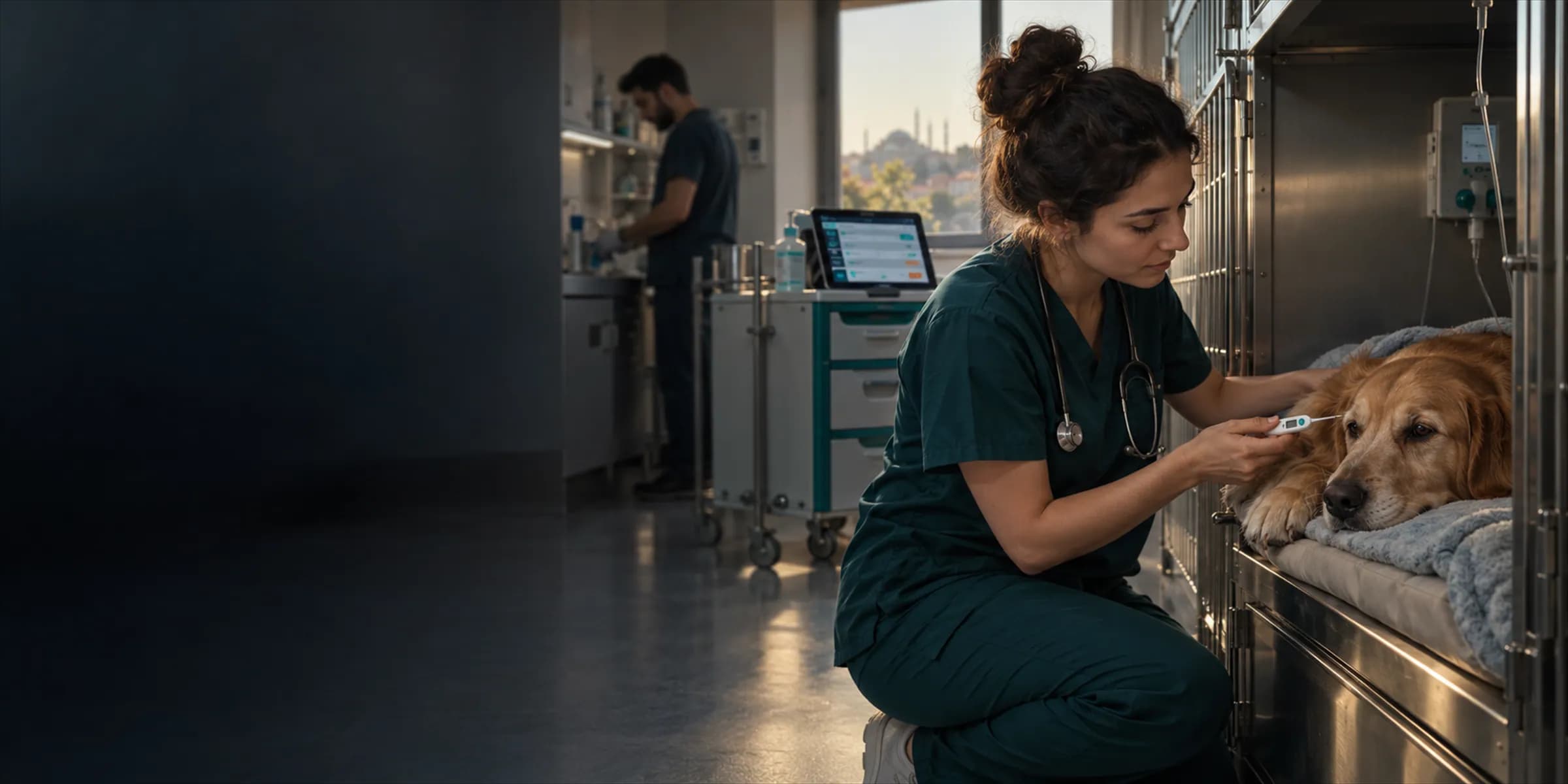
A hospitalized patient is the most delicate work a clinic does: the animal is your responsibility overnight, the people caring for it change with each shift, and whether a drug was given depends on a single entry. When inpatient monitoring runs on scattered paper notes, the riskiest moment is the shift change. VetBis hospitalization keeps the room board, admission status and treatment plan in one patient record; a separate daily vital signs and medication administration log does not exist in the product, so you keep the template in this guide on your own form for that part. This guide offers an inpatient monitoring routine you can use with any tool.
Note: this article is about record-keeping and process. Clinical decisions, treatment protocols and normal ranges are for your veterinarian to judge.
What an inpatient record should contain
An inpatient record has two layers: information entered once at admission and information updated every day (or every hour, if needed).
Once, at admission
| Field | Content |
|---|---|
| Reason for admission and diagnosis | The vet's decision and working diagnosis |
| Admission date and time | Start of the monitoring period |
| Room and room type | Standard, intensive care, isolation, recovery and so on |
| Starting weight | For dose calculation and tracking progress |
| Owner consent | Admission and cost information, contact person |
| Allergies and chronic conditions | Anything that affects drug choice |
| Feeding plan | Food type, amount, special diet |
Every day (or every check)
| Field | Content |
|---|---|
| Vital signs | Body temperature, weight, heart rate, respiratory rate, capillary refill time |
| General condition | Alertness, activity, appetite, water intake |
| Output | Urine and stool, vomiting |
| Medication and treatment | Drug, dose, route, time, who gave it |
| Fluids | Type, rate, finish time |
| Notes | Observations for the vet, changes to the plan |
Room 1
Standard · 1
Room 2
Standard · 1
Intensive care
Intensive care · 2
Karabas
Dog
Discharged
Exit · 1
Pamuk
Cat
- Room chosen
- Admitted
- Treatment plan
- Discharged
Live flowDischarged 4 / 4
Steps
- 1Room boardFree and occupied rooms are visible at a glance.
- 2AdmittedPatients settle into their rooms and the admission record starts.
- 3Treatment planAdmission status and treatment plan are updated for Karabas; moved to intensive care.
- 4DischargedPamuk is discharged and the room frees up again.
Sample patients are fictional. VetBis does not keep a daily vital or medication log; it records admission status and the treatment plan.
Keeping a daily vital signs record
Which vital signs are recorded?
Most clinics record five basics at each check: temperature, weight, heart rate, respiratory rate and capillary refill time. VetBis has no separate daily vital record; keep these fields on your own paper or digital form and summarise them in the treatment plan note. Your vet can add further parameters (blood glucose, for example) depending on the patient.
Who decides how often?
Frequency depends on the patient: more often for a critical case, less often for a stable one. What matters is that the vet sets it in writing and every shift knows it. An instruction such as "vitals every 4 hours" should be visible on the record.
Habits that prevent bad records
- Record right after measuring. Writing from memory later invites errors and gaps.
- Keep units fixed. Temperature in degrees Celsius, weight in kilograms; mixed units can turn into dosing errors.
- Write the time of measurement. You need the time to see a trend.
- Record the number, not just "normal". A trend only shows with figures.
Medication log: one answer to "was it given?"
The most common inpatient error is uncertainty about whether a drug was given: either it was missed or it was given twice. The routine that closes this gap is simple:
- The vet writes the drug, dose, route (oral, intravenous, subcutaneous), frequency and duration.
- When the drug is given, the person administering it records the time and dose.
- If a scheduled dose was not given, the reason is written (patient vomited, refused, vet stopped it).
- Dose changes are written into the record by the vet; old and new doses are not confused.
Medication record checklist
- The patient's current weight is reflected in the dose calculation
- Allergy and chronic-condition notes are visible
- Time, dose and person recorded for every drug
- Extra records kept for controlled drugs or those needing special tracking (follow the relevant regulations and your vet for the required detail)
- Fluid therapy has type, rate and finish time written down
Making sure used drugs and consumables reach the stock record and the invoice is a big part of being transparent about inpatient costs. The benefit of keeping inventory and the inpatient record in one system is that these items do not scatter across separate books.
Shift hand-over
The inpatient record gets its real test at hand-over. Try this structure:
A five-minute hand-over template
- Patient and room: who, which room, reason for admission
- Last 12 hours: key events, drug changes
- Right now: latest vitals, appetite, output
- Pending: next drug times, requested tests, decisions the vet still has to make
- Warnings: aggressive, flight risk, suspected contagion
Even if hand-over is spoken, read it from the record so both shifts look at the same information. For rota planning, see staff management.
Rooms and isolation
Separating inpatients by room type is both a clinical and a hygiene requirement:
| Room type | Purpose |
|---|---|
| Standard | Stable patient under observation |
| Intensive care | Patient needing close monitoring |
| Isolation | Patient with suspected contagious disease |
| Recovery | Post-operative recovery |
| Boarding | Care-only stay with no medical need |
An animal with a suspected contagious disease should be kept apart from the others and should show a separate room type in the record. Keep pet hotel guests apart from inpatients; see our pet hotel guide for more.
Communicating with the owner and being clear about costs
Inpatient treatment is often costly and emotional. These habits build trust:
- Share an estimated cost range and treatment plan before admission.
- Agree on an update time (every evening, for instance).
- Tell the owner the same day about any significant change (deterioration, extra procedure) and record their approval.
- Give written home-care instructions before discharge.
Discharge checklist
- The vet has written the discharge decision in the record
- Home medication, dose and duration given in writing
- Feeding and activity restrictions explained
- Follow-up appointment booked
- Services and products used during the stay are on the invoice
- The patient's belongings returned
- The owner knows who to contact in an emergency
Common inpatient mistakes
- Measuring vitals and leaving the record for later
- Giving a drug without writing the time
- Handing over verbally instead of from the record
- Not writing dose changes into the record
- Trying to collect extra charges at discharge
FAQ
Is an inpatient record the same as a pet hotel record? No. An inpatient needs medical monitoring; a pet hotel is a care service. Keep them apart in the record and in physical space.
Are vital signs analysed automatically? This article is about record-keeping. Clinical interpretation of values belongs to the vet.
Can inpatient and lab results be connected? Tracking an inpatient's test requests and results inside the patient record is possible; see the guide to lab result tracking and reference ranges.
Next step
This week, put your inpatient template (vital fields, medication log, hand-over) in writing. Then try VetBis free for 7 days and run the room board, admission status and treatment plan with your own cases.