
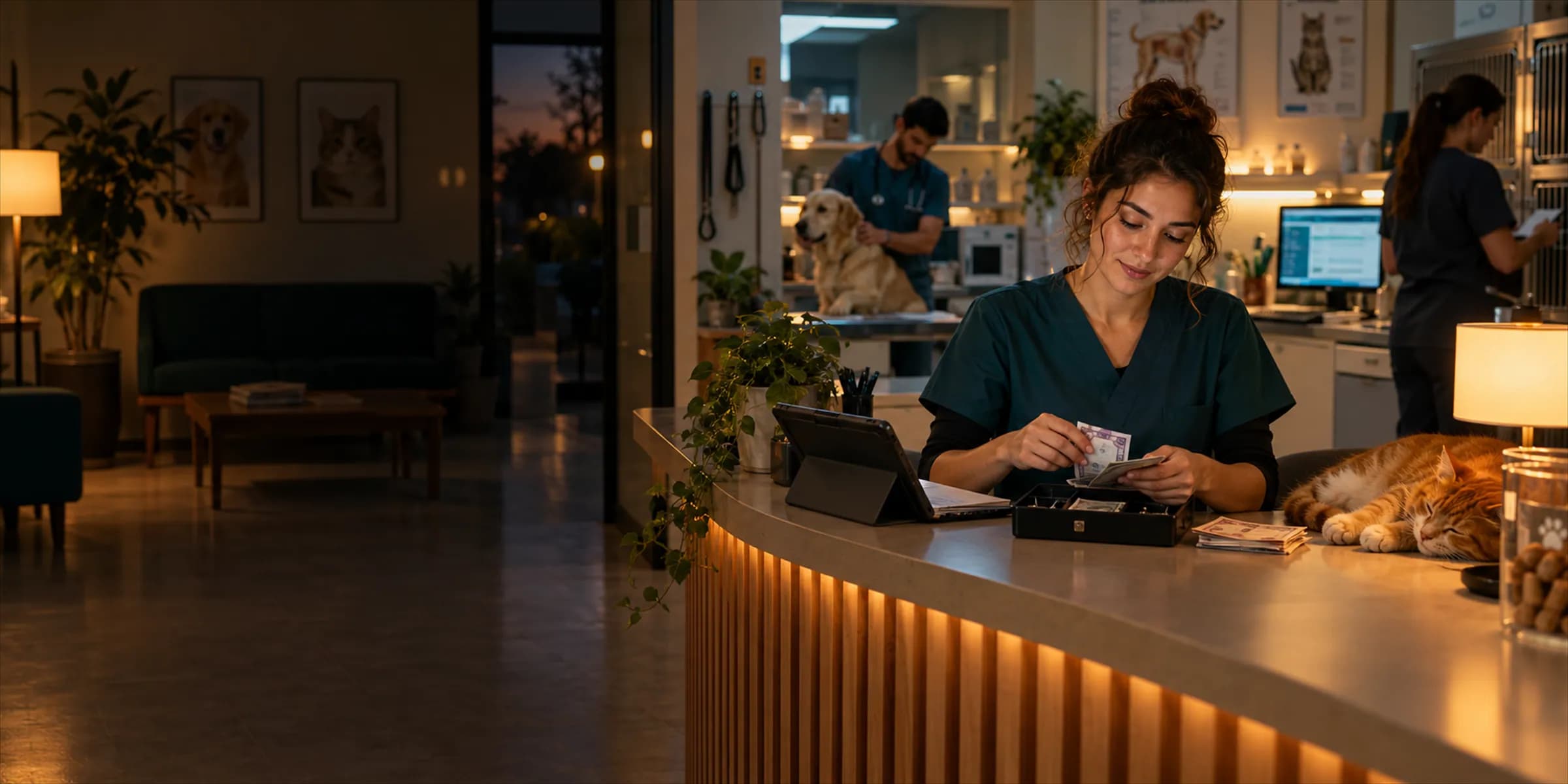
In a veterinary clinic, cash differences rarely come from one big mistake. They come from small unrecorded events: a payment taken with a discount, a balance put on account and later paid in cash, change handed out of the drawer. This guide describes a routine you can apply from cash opening to end-of-day closing. It works the same whether you use software or a paper ledger; software simply makes it easier to follow. VetBis covers cash sessions, cash movements and customer accounts on the cash desk and collections page.
Why close the day?
End-of-day closing answers "what came in, what went out and what is left?" on the same day. A difference found today is easy to trace; found next week, it is nearly impossible. Regular closing has three concrete benefits:
- Differences are caught the same day.
- It is clear who worked which cash session.
- Your accountant receives orderly, checked data.
The cash routine: four stages
1. Morning: opening the cash session
At the start of the day the opening float in the drawer is counted and recorded. It should match the amount carried over at the previous day's close.
Checklist:
- Cash in the drawer counted and opening amount written down
- Opening amount matches yesterday's carried-over balance
- Who opened the cash session is recorded
- Enough small change on hand
Do not take payments before a cash session is open. Otherwise it is unclear which session a transaction belongs to.
2. During the day: payments and cash movements
Each payment is recorded against the relevant invoice or customer account. The payment method (cash, card, bank transfer) must be right, because each method is totalled separately at day end.
Daytime rules:
- Exams, vaccines, product and service sales become an invoice or sale record; "we will write it up later" is not allowed.
- If a discount is given, the reason and the authorizing person show on the record.
- If a partial payment is taken, the remainder stays as a balance on the customer account.
- It is clear to the owner which service each payment covers.
- Every payout from the drawer (courier, cleaning supplies, small purchases) is recorded as a cash movement with a category.
For quick retail sales, the barcode quick sale flow can be used; the product page states which parts are ready and which are not.
3. Evening: end-of-day closing
Closing begins with a count.
- Count the cash and record it as "counted cash".
- Calculate the cash the system expects (opening + cash received − cash paid out).
- Find the difference. If there is one, look for the cause.
- Compare card and transfer totals with the card terminal's end-of-day report or the bank movements.
- Check for open items (unfinished invoices, sales awaiting payment).
- Close the cash session and set the carried-over amount.
Sample closing table (figures are fictional):
| Item | Amount |
|---|---|
| Opening (carried over) | 1,000 |
| Cash received | 7,400 |
| Cash paid out (cash movement) | 350 |
| Expected cash | 8,050 |
| Counted cash | 8,050 |
| Difference | 0 |
| Card payments | 12,900 |
| Bank transfers | 2,100 |
If the difference is not zero, check in this order: an unrecorded cash payout, a payment recorded under the wrong method, a cancelled or refunded transaction, a change-giving error, a payment recorded to another drawer.
4. Next morning: carry-over and history
A closed session should remain as a history record that cannot be edited. If a correction is needed, add a separate correction entry rather than overwriting the record. This keeps both you and your accountant able to trace it.
Cash session
| Opening carry-over | TRY 1,500.00 |
|---|---|
| Exams and procedures | TRY 1,450.00 |
| Food and product sales | TRY 850.00 |
| PaymentCash | -TRY 1,500.00 |
| PaymentCard | -TRY 800.00 |
| Total sales | TRY 2,300.00 |
| Difference | TRY 0.00 |
Live flowEnd-of-day closing 4 / 4
Steps
- 1Cash openingThe carry-over is counted and compared with yesterday's closing.
- 2Sales through the dayExam and product lines are posted to the session.
- 3PaymentsCash and card payments are recorded against the sales.
- 4End-of-day closingCounted cash is compared with the record; a zero difference closes the day.
Sample amounts; not real clinic data.
Customer accounts and receivables
Part of a vet clinic's real revenue begins as "I will pay later". The customer account holds each owner's balance and statement.
- Weekly: list the owners with open balances.
- Reminders: send a polite, recorded reminder to owners who are past due. In VetBis, debt and sales reminder lists are described on the relevant page; sending reminders by SMS or WhatsApp depends on a separate notification integration, so check its status on the product page.
- Adjustments: if a manual balance adjustment is made, its reason should be written.
Roles and responsibility
The cash desk should not be an area everyone touches.
| Role | Suggested permission |
|---|---|
| Reception | Open cash, take payments, close their own session |
| Clinic manager | View all sessions, cash categories and approve corrections |
| Accounting | View reports and statements |
| Vet | Usually no cash operations; sees invoice items |
When several people use the same drawer, opening sessions per person makes accountability easier. For staff and permission management, see staff management.
Handing over to the accountant
At month end it is enough to give your accountant:
- Daily cash summaries (by payment method)
- The list of issued invoices
- Cash payout movements and their categories
- Supplier payments
- Open customer balances
Being able to export data matters; check in what formats reports can be exported on the billing page and in the product documentation. For official document obligations such as e-invoice or e-archive, consult your accountant; this article contains no tax advice.
Weekly and monthly checklist
Every week:
- Is any cash session left unclosed?
- Is there a day or staff member with repeated differences?
- Have open balances been reviewed?
Every month:
- Has expense distribution by cash category been reviewed?
- Were card and bank totals matched with the statements?
- Was the handover to the accountant done?
For how a clinic program ties these reports together, see what is veterinary practice software.
Common mistakes
- Taking payments without opening a session.
- Not recording a cash payout.
- "Fixing" the payment method afterwards.
- Dismissing a difference as "small"; repeated small differences point to a systematic error.
- Closing every two or three days in one batch.
- Giving everyone cash permissions.
Frequently asked questions
What should I do if there is a cash difference? First look for an unrecorded payout, a wrong payment method, and refunds or cancellations. If the difference cannot be explained, add a correction entry and note the reason; do not silently ignore it.
Who should do the end-of-day closing? The person who opened the session does the count; a second check by a manager is good practice.
Does a card payment enter the drawer like cash? No. The payment method is recorded separately and cash and card are totalled separately at day end.
What if I notice a mistake in a closed session? Instead of changing history, add a correction entry with an explanation.
Conclusion
Open the session, record every payment, count and check the difference, close the session: applied with discipline, these four steps shrink cash differences and lighten accounting work. See this flow in VetBis on the cash desk and collections page and try it free for 7 days.