
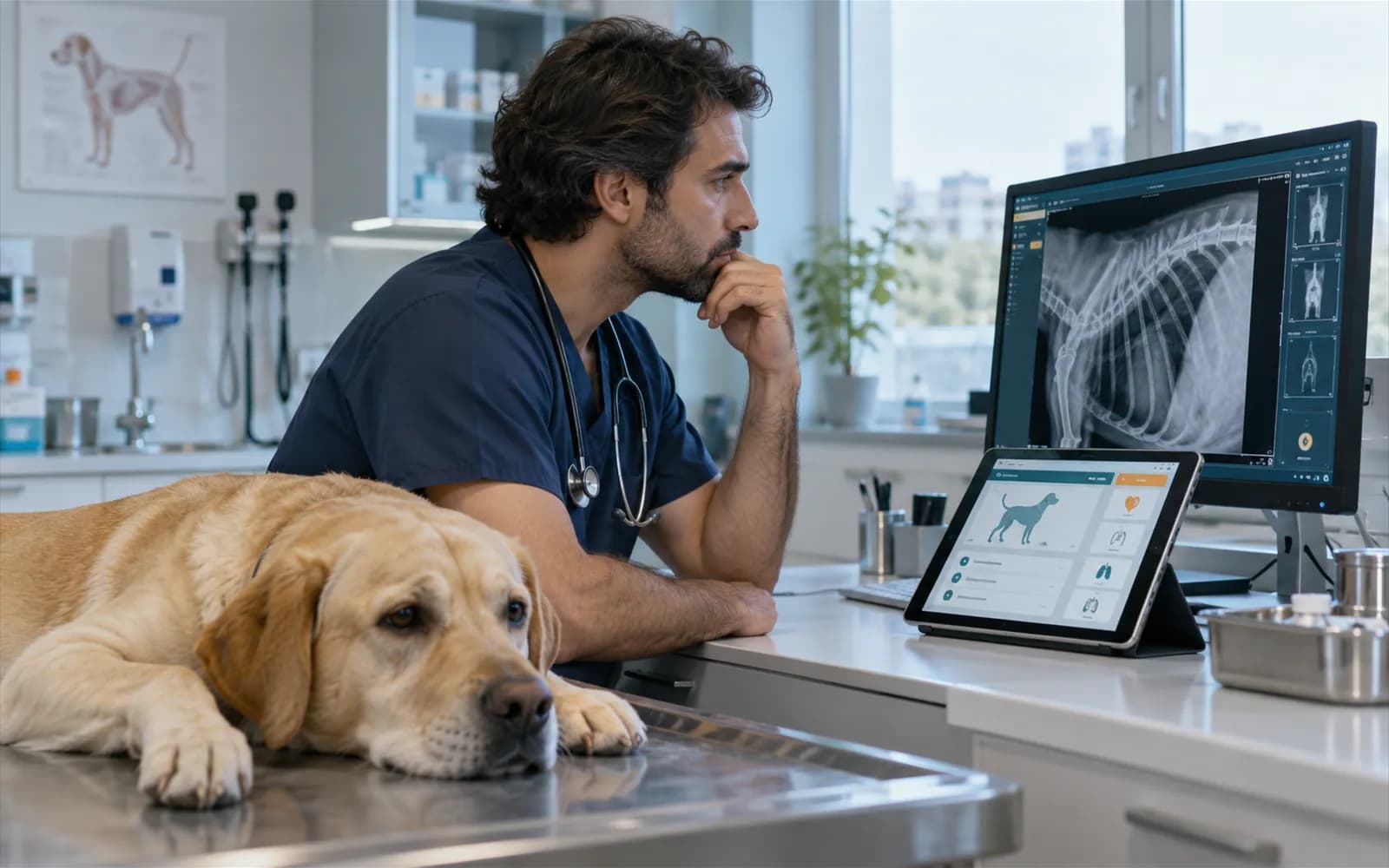
AI does not diagnose in veterinary medicine; it gives the vet decision support. That distinction matters for patient safety and for accountability alike. This article covers where AI is genuinely useful in a clinic, where it has to stop, and how it should sit inside veterinary practice software. The AI assistant in VetBis is in beta and offers preliminary-diagnosis suggestions and case prioritisation (triage); the final decision always belongs to the veterinarian.
What does decision support mean?
A decision support system looks at the findings the vet enters and suggests possibilities. The vet accepts, changes or rejects the suggestion. The record and the responsibility stay with the vet. The system cannot see, touch or listen to the animal; it only works with what someone types in. The quality of its output therefore depends first on the quality of the input.
In software, the label "AI" covers a wide range, from simple rule engines to large language models. The question a clinic should ask is not "does it have AI?" but "what is this output used for, and who signs it off?"
Where it is used in a clinic
| Area | What it offers | Limit |
|---|---|---|
| Preliminary diagnosis suggestions | Ranks possible diagnoses from complaint, species, age and findings | Never replaces the exam or lab results |
| Triage | A first draft of the urgency order for incoming cases | The vet or lead technician finalises the order |
| Drug interaction warnings | Flags possible interactions when several drugs are prescribed | Not a ready-made screen in VetBis; on the roadmap |
| Image analysis | Finding detection on radiographs and ultrasound | A field for dedicated products and research; not in VetBis |
Preliminary diagnosis suggestions
When complaint, species, age and clinical findings are entered, the system can rank possible diagnoses. Its biggest value is reminding the vet of a possibility that may slip past on a busy day. You are never obliged to accept a suggestion; what matters is putting it next to your own differential list and comparing the two. Unless it is backed by a clinical exam and, where needed, lab results, a suggestion is not a diagnosis.
Triage
At a busy hour the front desk constantly faces the question "who should be seen first?" Triage support proposes an initial urgency order based on the complaint. That order can complement the assessment made at the door or on the phone, but for obvious emergency signs such as breathing difficulty, bleeding or altered consciousness, the clinic's own emergency protocol comes first.
What AI cannot do
- It cannot examine the animal.
- It does not produce a correct result from missing or wrong input.
- It cannot take over the vet's responsibility.
- It can produce a wrong, incomplete or invented suggestion, and it does not know when it has.
- It does not automatically know your local conditions, your drug stock or the patient's full history.
So output should always be weighed against sourced clinical knowledge and the vet's own judgment. Trusting a suggestion because it "sounds reasonable" is the most common mistake with AI.
My dog has been vomiting since this morning and will not drink water.
Suggestion: may not be an emergency but could need a same-day exam. The final assessment is the vet's.
Decision support
The vet reviewed the suggestion and booked an appointment for today.
Vet approvedSample chat · beta
Live flowVeterinarian approves 3 / 3
Steps
- 1Owner writesThe complaint is recorded.
- 2Assistant drafts a suggestionA priority suggestion arrives with a confidence level.
- 3Veterinarian approvesThe suggestion is used only after vet approval.
The assistant does not diagnose; a suggestion is never applied without vet approval.
Where VetBis stands
The VetBis AI assistant is in beta. The clinic screens include preliminary-diagnosis suggestions and case prioritisation (triage), and the mobile clinic app has a preliminary-diagnosis screen too. The assistant connects to an external AI provider; if no provider is configured, the feature stays off. Results are presented as decision support and used with the vet's approval. Drug interaction warnings and image analysis are not part of the product today. See the feature page for the current scope.
How to fit AI into the clinic workflow
A practical setup puts the assistant after the vet's own assessment as a "second look", not at the start of the visit:
- The vet enters history and exam findings. For a well-structured record, see the SOAP notes guide.
- If needed, the assistant is asked for a preliminary-diagnosis suggestion.
- The vet compares it with their own differential list, drops what does not fit and considers anything they overlooked.
- The decision and its reasoning are written to the clinical record under the vet's name. Records live in the clinical management screens.
- If the assistant output and the vet's decision keep diverging, the team reviews input quality and how the tool is being used.
Data and KVKK
You need to know whether the input sent to an AI service contains personal data, where it goes and how it is stored. Do not type the owner's ID number, phone or address into free-text fields; a suggestion does not need them. Ask the provider in writing how it uses the data and whether it retains it. For the wider framework, see the KVKK checklist. This article is not legal advice.
Checklist for using AI in the clinic
- The team has been told the output is decision support
- The final decision and the record stay with the vet
- No unnecessary personal data goes into free text
- Each suggestion is compared with the clinical findings
- In emergencies the clinic's own protocol comes first
- The provider and data flow have been confirmed in writing
- The workflow continues unchanged when the assistant is off (no provider)
Frequently asked questions
Can AI diagnose? No. It can rank possible diagnoses, but a diagnosis comes from the exam, lab work and the vet's judgment.
Will AI replace the vet? No. The record, the decision and the responsibility stay with the vet; the software only offers a second look.
Is it useful in a small clinic? In a solo practice, where there is nobody else to consult, a second look can be valuable. The same conditions apply: good input and vet approval.
Is the assistant always on? No. It connects to an external AI provider, so it stays off when no provider is configured. The product is in beta.
Should I show the AI output to the owner? It is safer to share your own assessment and plan than the raw output, which is a suggestion that has not been through vet approval.
Conclusion
AI can speed up a vet's work but does not replace it. The clinics that get the most from it set expectations correctly from day one, keep their input clean and leave the final call with the vet. Start by getting your record-keeping in order; with messy records, no suggestion adds value.